
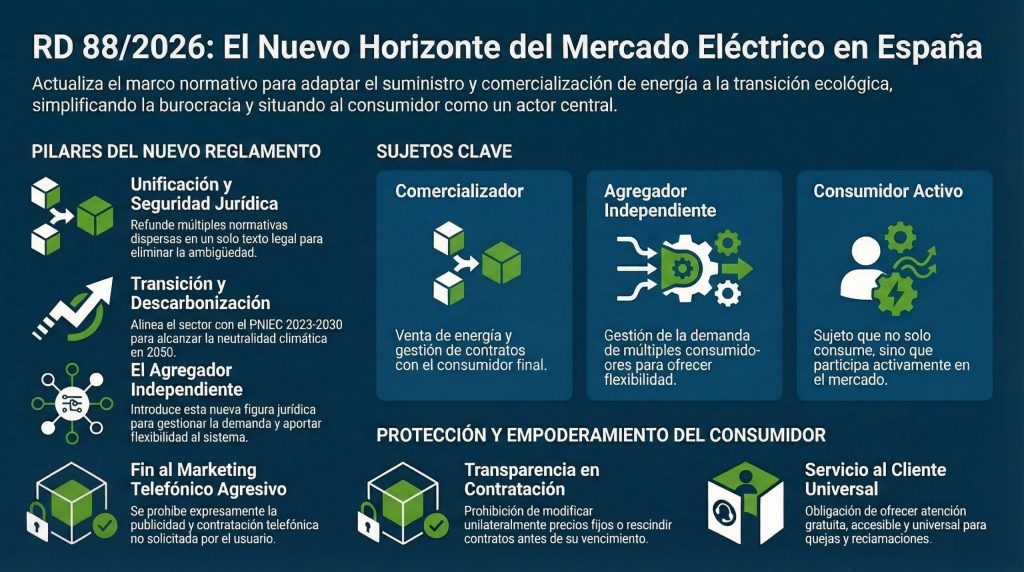
Royal Decree 88/2026, published in the Official State Gazette (BOE) on 12 February 2026, approves the new General Regulation on the supply, retail and aggregation of electricity. For businesses, the new framework introduces three particularly significant changes: it regulates the role of the independent aggregator, strengthens access to energy data, and opens the door to temporary changes in contracted capacity.
Although part of its implementation still depends on further regulatory developments, in this new context companies must stop managing energy as a purely administrative matter.
Content table
Why Was Royal Decree 88/2026 Introduced?
The regulations governing electricity supply in Spain had gone decades without a comprehensive review. Much of this framework was adopted even before Law 24/2013 on the Electricity Sector, in a context where consumers were passive participants and the digitalisation of the system was still at an early stage.
The sector has changed radically. The growing share of renewables, the widespread rollout of smart meters, the electrification of industrial processes, and the requirements introduced by European regulation made a far-reaching update of the framework governing the retail market unavoidable.
The result is a regulation that partially transposes Directive (EU) 2019/944 on the internal electricity market, develops the role of the independent aggregator, and lays the foundations for a more flexible, digitalised energy system centred on the active consumer.
What Changes at a Glance
Regulatory Change | What It Means for Businesses |
Agregador independiente | Demand can begin to be managed as a resource with market value. |
Enhanced Access to Data | It improves consumption analysis and energy decision-making. |
Temporary Changes to Contracted Capacity | It allows companies to better adapt their contract to changing operational needs. |
More Flexible Contracts | It opens up new options for purchasing and managing electricity supply. |
Cambio de comercializadora más ágil | It reduces operational friction in energy reviews and tendering processes. |
The Most Significant Changes Introduced by Royal Decree 88/2026
The Independent Aggregator Enters the Scene
The most significant new feature is the explicit regulation of the independent aggregator. The regulation recognises that consumers may enter into an aggregation agreement with an entity other than their electricity supplier, without requiring the supplier’s consent. It also establishes that the independent aggregator may operate in electricity markets without the consent of the customer’s supplier. Consumers may therefore sign an aggregation contract with a third party other than their usual supplier, with no additional cost or penalty.
2. Energy Data Management Becomes a Strategic Asset
The regulation clearly strengthens access to supply point information. Consumers are entitled to access their metering data free of charge and to expressly authorise its transfer to third parties. Distribution system operators may not impose conditions on such access, and the system operator will take on the centralised management of information for all supply points as a single access point.
3. Temporary Changes to Contracted Capacity
Another important change is the possibility of requesting temporary modifications to contracted capacity. Article 38 allows for quarterly, monthly, daily and hourly timeframes, and permits the accumulation of modifications across different time horizons, although not within the same horizon. It also requires such requests to be submitted at least five working days before the start of the relevant period.
The National Commission on Markets and Competition (CNMC) will have to determine the applicable prices and billing conditions, and the decree itself makes clear that these changes will only take effect once the CNMC sets the corresponding increases in capacity charges, and in any case not earlier than six months after the Royal Decree enters into force.
Operational implementation also matters. These changes must be applied within a maximum of 72 hours and, where on-site work is required, the deadline is extended to five working days for low voltage and ten working days for high voltage. For companies with seasonal campaigns, variable shifts or highly irregular consumption, this measure could become a concrete source of savings if supported by monitoring and analysis. Contracted capacity is likely to become a more dynamic and less rigid variable than under the traditional model.
4. Consumer Rights Are Strengthened
The new regulation grants consumers the right to hold more than one electricity supply contract simultaneously at the same supply point, provided that consumption is properly recorded and the access agreement is signed directly with the relevant distributor. It also recognises the right to enter into an aggregation agreement either with their existing supplier or with an independent aggregator.
In addition, the text recognises the right to enter into dynamic electricity pricing contracts with any supplier serving more than 200,000 final customers, provided that the consumer has a suitable meter with remote reading capability. The regulation also states that consumers must be informed of the opportunities, costs and risks involved, and must receive an estimated monthly bill before entering into the contract.
5. Supplier Switching Will Be Faster
The maximum time allowed to complete a supplier switch is set at ten working days from the signing of the contract. The technical process itself may not exceed twenty-four hours. Safeguards against unauthorised switching are also strengthened, including the obligation to restore supply with the original supplier and to compensate for any damages in the event of an error.
What Does Royal Decree 88/2026 Mean for Your Company’s Energy Management?
The first consequence is that managing when you consume electricity will become increasingly important, compared with a model focused almost exclusively on how much you consume. The decree’s preamble itself explains that demand response must play an essential role as a source of flexibility and that it can deliver economic benefits to the end consumer.
The second is that energy monitoring is no longer just a nice-to-have and is becoming much closer to a practical necessity. Without high-quality data, a company will face serious difficulties in making the most of dynamic contracts, reviewing contracted capacity, assessing aggregation opportunities, or identifying consumption patterns that could be improved. This conclusion aligns directly with the stronger regulatory framework for data access and with the importance the decree places on the management of consumer information.
The third implication is strategic. This new environment demands more than simply purchasing energy at a good price. It requires a clear understanding of regulation, consumption behaviour, flexibility opportunities and regulatory implementation timelines. This is where a specialised energy partner can make the difference between merely reacting and turning regulatory change into a competitive advantage. This final point is a strategic interpretation of the new framework, supported by the direction set out in the regulation.
What Deadlines and Pending Developments Should Companies Watch Closely?
Royal Decree 88/2026 entered into force on 12 February 2026, but several of its most significant provisions still depend on further regulatory developments.
The independent aggregation model will not become operational until the CNMC adapts the necessary regulatory provisions to allow aggregators to participate in the markets, which must take place within a maximum period of three months from the date the Royal Decree entered into force. The articles relating to the most significant billing and contracting conditions will enter into force four months after publication.
Temporary changes to contracted capacity will not become applicable before six months have elapsed, and their implementation is subject to the CNMC setting the corresponding increases.
In parallel, the system operator has two months to submit to the Ministry a proposal for the operating procedure relating to the aggregation model.
All of this makes it particularly important to closely monitor regulatory developments over the coming months, as the pending implementing measures will largely determine the real scope of the opportunities opened up by this Royal Decree.
FAQs on Royal Decree 88/2026
It is the regulation that approves the new General Regulation on the supply, retail and aggregation of electricity in Spain. It was published in the Official State Gazette (BOE) on 12 February 2026 and entered into force on the same day.
No. It also affects business consumers, especially those with significant electricity consumption, multiple supply points, or the ability to manage their demand more effectively. The regulation covers consumer rights, contracting, data access, supplier switching, and aggregation.
Yes. The regulation establishes that consumers may enter into an aggregation contract with an entity other than their electricity supplier, without requiring the supplier’s consent.
Yes, under certain conditions. The regulation allows this where consumption is properly recorded and the access agreement is signed directly with the relevant distributor.
Not fully or immediately. The Royal Decree regulates them, but their practical application depends on the CNMC setting the corresponding increases in capacity charges and, in any event, they do not take effect until at least six months after the Royal Decree entered into force.
Not exactly. The incoming supplier must submit the switching request to the distributor within 24 hours on a working day, but the consumer is entitled to have the switch completed within a maximum of ten working days, with an exceptional extension possible if complex on-site actions are required.
In the Official State Gazette (BOE), which is the official source of Royal Decree 88/2026 and the regulation it approves.